
Photo Print Finishes: Gloss vs Matte
Gloss makes colours pop but shows glare and fingerprints; matte is soft and handles beautifully but mutes colour slightly. An honest comparison, use case by use case.
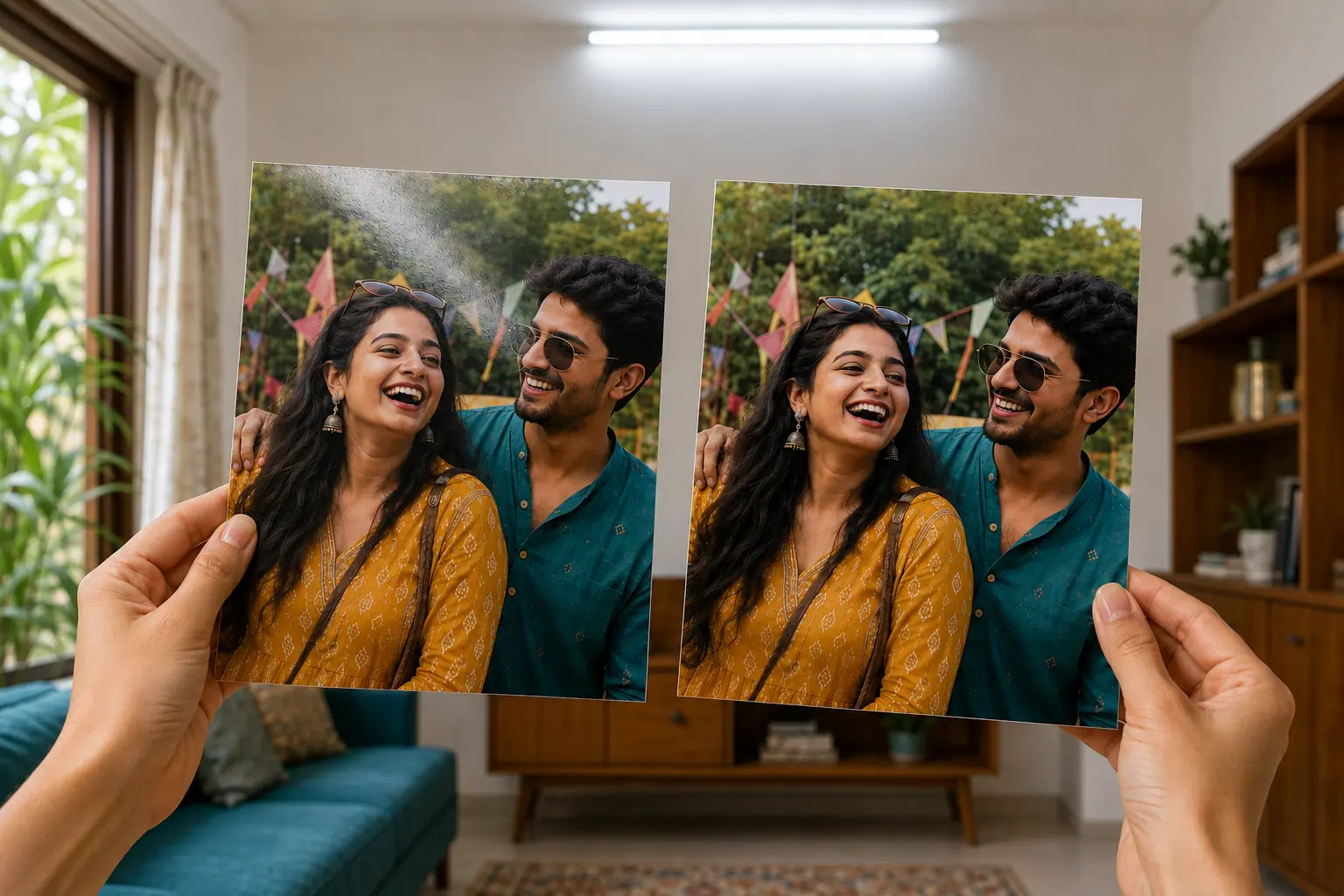
The honest answer on gloss vs matte photo prints: gloss gives you maximum colour pop, contrast and sharpness, but it reflects light and collects fingerprints; matte gives you a soft, premium, glare-free surface that handles beautifully, at the cost of slightly muted colours. Neither is better. Each wins in specific situations. Here is the full comparison, including which finish suits albums, walls, frames under glass, and the lighting in Indian homes.
What the two finishes actually are
The difference is the surface coating. A gloss print has a smooth, reflective top layer that bounces light back at the viewer, and that bounce is what makes colours look saturated and blacks look deep. A matte print has a non-reflective surface that scatters light instead of bouncing it, which is why it looks softer and shows no glare from any angle.
Photo-paper makers describe the trade-off the same way. Red River Paper's guide to glossy vs matte paper explains that a glossy coating reflects light back to lift colour and contrast, while a matte surface refracts light instead of bouncing it, which is exactly what removes glare at the cost of a little saturation. The physics doesn't change with the brand of paper: more reflection means more punch and more glare; less reflection means less punch and no glare.
The case for gloss
- Colour vibrancy: saturated colours, like wedding lehengas, Holi photos, beach water and festival lights, look their absolute best on gloss. The reflective coat amplifies saturation in a way matte physically cannot.
- Contrast and depth: blacks look deeper and whites brighter, so high-contrast photos (night shots, stage events, city lights) keep their drama.
- Perceived sharpness: fine detail reads crisper on gloss, which flatters detailed shots like jewellery close-ups, mehendi patterns and landscapes.
- The familiar look: gloss is what most of us grew up with, the classic studio-print look of family albums from the 90s. For many people it simply feels like a photo.
And the honest costs: gloss shows every fingerprint the moment the print is touched, and under a direct light source you will angle the print to see past your own reflection. Photography educators note the same drawbacks. ExpertPhotography's glossy vs matte comparison lists fingerprints, smudges and glare in bright rooms as the standing weaknesses of glossy paper, and notes that glossy prints can even stick to the glass when framed.
The case for matte
- Zero glare: a matte print is equally viewable from every seat in the room and under any light. Nothing to angle, nothing to squint past.
- Handles beautifully: no fingerprints, no smudges. A matte print passed around a room full of relatives comes back looking exactly as it left.
- The premium read: matte is the finish of gallery prints and coffee-table books. Skin tones look softer and more natural, which is why portrait photographers often default to low-sheen finishes.
- Plays well with frames: under glass, a matte print adds no reflections of its own, since the glass already contributes enough.
The honest costs: colours are slightly muted compared to gloss (visible side by side, less so in isolation), and very dark, moody photos lose a little of their depth.
Lighting in Indian homes: the deciding factor most people skip
Most finish guides are written for soft, diffused Western interiors. Indian homes are a harder test for gloss. Living rooms typically combine strong daytime sun through large windows with hard, directional artificial light in the evening, like tube lights, LED battens and ceiling panels, all of which are exactly the kind of point sources that turn a gloss surface into a mirror. A gloss print on a wall opposite a window or under a tube light will spend hours a day showing you the room's reflection instead of the photo.
This is why the practical rule of thumb in Indian homes is: gloss for prints viewed in hand, matte for prints viewed on walls. A print you hold, you can angle; a print on the wall, you cannot.
Which finish for which use
Photo albums: gloss, usually
Album pages are viewed in hand under varied angles, so glare is momentary and self-correcting, because you tilt the album. Colour pop matters more here, especially for wedding and travel albums. One caveat: if the album will be handled constantly by many guests, matte's smudge resistance becomes the stronger argument.
Wall display without glass: matte
Prints pinned, taped or clipped to fairy lights, a default in hostels, rentals and kids' rooms, face the room's light all day. Matte keeps them readable from every angle and clean despite the occasional touch.
Frames under glass: matte
The glass already adds one reflective layer; a gloss print behind it adds a second, and the two together can make the photo hard to see except head-on. A matte print under glass keeps the framed piece readable. If you want vibrancy and wall display together, the better route is often a different product class entirely: see our canvas vs framed vs acrylic comparison.
Prints guests will handle: matte
Table-scattered prints at parties, photo guest books, prints handed around at family gatherings: anywhere fingers meet surface repeatedly, matte wins outright.
Gifting a stack of memories: mix them
A popular move is ordering the same set twice, gloss for the album and matte for the wall, or splitting an order: colourful celebration shots in gloss, portraits in matte. With our photo prints starting at ₹520, testing both finishes with the same photo is a cheap experiment that settles your preference permanently.
Match the finish to the photo, too
Beyond use case, the content of the photo has a vote:
- Choose gloss for: festivals, weddings, travel landscapes, night shots, anything where colour is the point.
- Choose matte for: portraits, baby photos, black-and-white images, soft-light photos, anything where mood is the point.
Whichever you pick, the finish can only work with the detail your file contains: a soft, low-resolution image stays soft on both papers. Check your file against our photo resolution printing guide before ordering. We accept HEIC, JPG and PNG uploads, and every order passes a human preprint check, so a file with a resolution problem gets flagged before it is printed.
Keeping either finish looking new
Whichever finish you choose, a little handling discipline extends the life of the print:
- Hold prints by the edges. Second nature for matte, essential for gloss: skin oils are the main enemy of a gloss coating.
- Store loose prints in sleeves or boxes, not rubber-banded stacks. Gloss surfaces pressed together in humid weather, which covers most of the Indian monsoon in most cities, can stick to each other and to glass.
- Keep prints out of direct afternoon sun. This is a display rule, not a finish rule: any printed photo lives longer on a wall that does not face hours of direct sunlight.
- Wipe with a dry microfibre cloth only. Never a damp cloth, and never household cleaners, on either finish.
Humidity deserves its own line for coastal readers: in Mumbai, Chennai or Kochi, matte prints both framed under glass and openly displayed fare better through the monsoon than unprotected gloss, simply because there is no tacky coating to attract moisture and dust. It is one more quiet vote for matte on walls in humid cities.
The short version
Gloss for colour and impact, viewed in hand. Matte for walls, frames, and anything people will touch. When in doubt for a gift, choose matte: it has no failure mode.
Print your photos in the finish that fits
Start a photo print order and choose your finish per photo. Prints from ₹520, free shipping on orders over ₹199, COD available, and delivery in 3 to 5 days across India. 10,392+ customers, 4.4 stars. For more printing guides, browse our photo prints topic page.
Frequently Asked Questions
Is gloss or matte better for photo prints?
Which finish is better for photos in a frame with glass?
Do matte photo prints look dull?
Which finish is better for Indian living rooms?
How much do photo prints cost?
People Also Ask
What photo finish do professional photographers use?
Are glossy photos sharper than matte?
What is the best finish for a photo album?
Do fingerprints come off glossy photos?
Related articles
 Christmas
Christmas and New Year Personalised Photo Gift Guide
Skip the generic hampers this Christmas. Personalised photo gifts turn the year's best moments into presents people actually keep.
Read More Birthday
Birthday Gift for Mom: Useful, Personal and Made from Her Own Photos
Mothers take most of the family photos and appear in the fewest. A collage made only of photos of her is a birthday gift she will not have seen coming.
Read More Birthday
Birthday Gifts for Dad: Photo Gifts He Will Actually Hang
When Papa says he needs nothing, he usually means he wants no more clutter. A framed photo of what he is proudest of goes on the wall and stays there.
Read More
Ready To Print Your Own Photos?
Turn your favourite memories into canvas prints, photo frames and photo collages — printed in India and delivered to your door.
Start Creating