
How to Order Custom Photo Frames Online in India
A step-by-step guide to getting a framed photo that fits your wall, your photo and your budget.
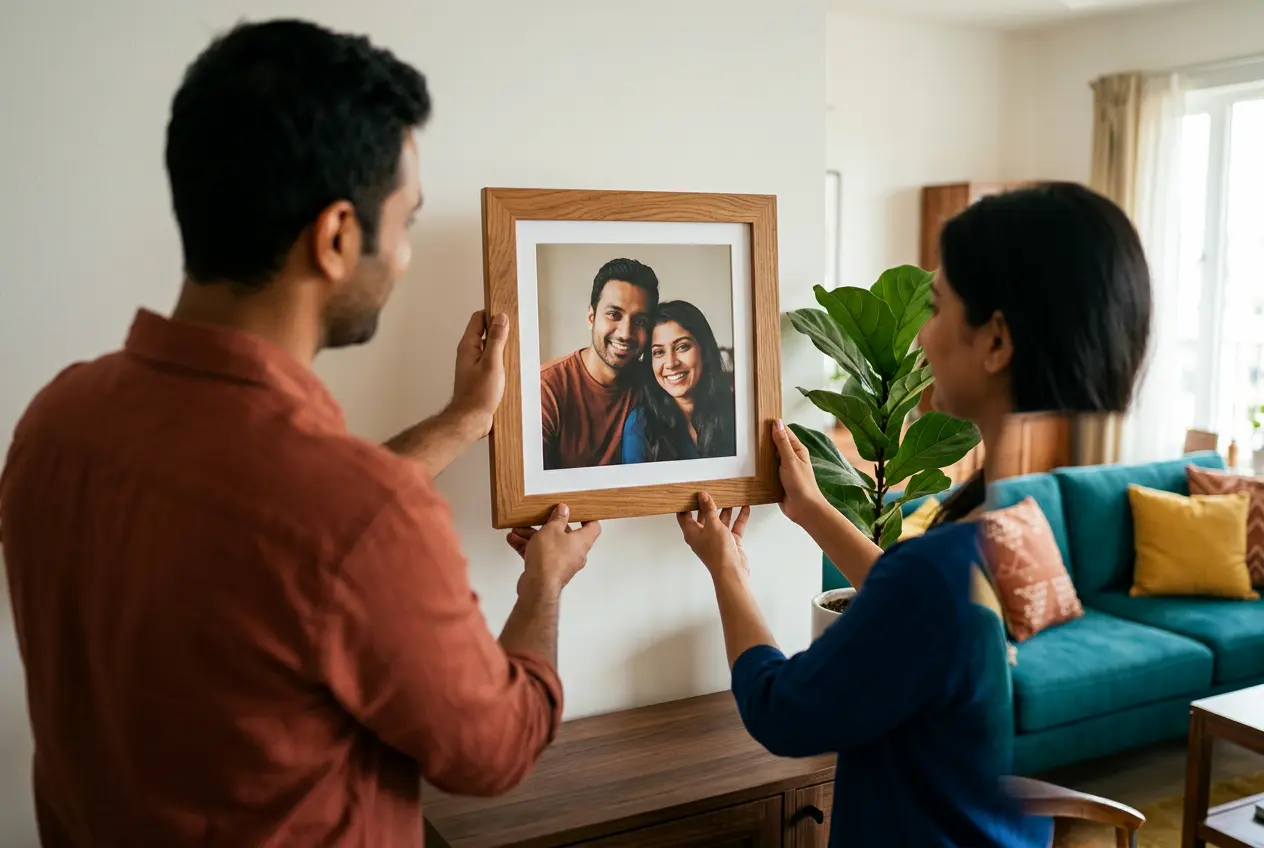
Ordering a custom photo frame online should be simple, but the screen asks for sizes in inches, a finish, a margin and a file, and most people guess. Framing is actually a small craft with its own rules, and knowing a few of them is the difference between a frame that protects and flatters a photo for decades and one that looks slightly off the moment it goes up. This guide explains how custom framing really works, then how to translate that into an online order.
The short version: a custom photo frame is built around one specific image. Instead of buying a stock frame and forcing a photo into it, you choose the size, the border and the finish to suit that photo, and it is printed and assembled as one piece.
What a custom frame is actually made of
A finished frame is a small stack of parts, and each one has a job. Knowing them helps you make better choices and ask better questions.
- The moulding is the visible outer frame. Its width and finish set the mood: a slim profile reads modern, a wider one reads classic.
- The mount or mat is the flat border between the photo and the moulding. It is the most underrated part of a frame.
- The backing holds everything flat and supports the photo from behind.
- The front layer protects the surface from dust, hands and light.
- The hanging system on the back determines how level and secure it sits.
Ready-made frames fix all of these in advance. Custom framing lets you set each one for your photo, which is why it fits properly and lasts.
The mount: the part that does the quiet work
If you change one thing about how you think about framing, make it the mount. A mat is not just a decorative border. According to the Library of Congress preservation guidelines, matting holds the image away from the front surface and shields it from physical and environmental damage. The materials matter: conservation framers use boards that are acid-free and lignin-free, made from cotton rag or purified wood pulp, because ordinary card slowly yellows and can mark whatever it touches.
There is a visual job too. A mat gives the eye a place to rest before it reaches the photo, which makes the image feel more deliberate and more valuable. A wider border reads as more formal and gallery-like; a narrow one or none at all feels fuller and more modern. Neither is wrong, but the choice should be deliberate rather than default.
Margin or no margin
Online this choice is usually called a margin. A margin gives a portrait or a gift a sense of occasion; no margin fills the opening edge to edge and suits bold, graphic photos. At picsin.in the white margin is a real physical border set around your printed photo inside the frame, not a white edge printed onto the image itself, so it reads as a true mount rather than part of the picture.
Protecting the photo for the long run
Traditional art framing leans on glazing, the clear front layer, often with UV filtering, to slow fading from light. For a printed photograph, longevity comes from two other places: the inks and the paper or surface. Pigment inks resist fading far longer than dye inks, and a stable surface holds colour for decades. This is why a well-made printed-and-framed photo can outlast a cheaply printed one many times over, even without museum glass. At picsin.in the photo is printed at 2400 x 1200 DPI with fade-resistant pigment inks rated to hold colour for over a century, which is where the durability comes from.
Wherever the frame ends up, keep it out of harsh all-day direct sunlight and away from very humid spots; both are hard on any photo over time.
Sizing: start with the photo, then the wall
Two measurements decide the size: the photo's shape and the wall's scale. The shape comes first. Every photo has an aspect ratio, the relationship between its width and height, and forcing a photo into the wrong-shaped frame either crops the edges or leaves gaps. Standard photographic ratios map cleanly to common frame sizes: a 3:2 image suits 4x6, 8x12 and 20x30 inches; a 4:3 image suits sizes near 12x18; a square suits 8x8 and 12x12. International A-series sizes show up too, with A4 at 21 x 29.7 cm and A3 exactly double it, as the standard frame size references set out.
Then scale to the wall. The most common framing regret is going too small. Above furniture, aim for a frame or arrangement about two-thirds the width of the piece below it. We make sizes from 8x8 to 54x54 inches with custom sizes between, so the wall sets the number. Our photo frame sizes guide works through this room by room.
Where to hang it, and how high
A correctly sized frame still looks wrong if it is hung too high, which is the most common mistake in homes. The gallery standard is to centre the image about 57 inches from the floor to the middle of the frame, the figure museums use because it sits at average eye level. In rooms with high ceilings, nudging that up by three to six inches keeps the piece from floating low. Above a sofa or console, leave roughly 6 to 12 inches between the furniture and the bottom of the frame. For a group, treat the whole cluster as one shape and keep the gaps between frames to about two to three inches. These figures come from interior and gallery practice on how high to hang pictures. If you are building a wall of several frames, our gallery wall guide covers spacing and layout.
Preparing the photo so it survives the size
The print can only be as sharp as the file. The single biggest quality difference comes from uploading the original photo straight from your gallery, not a screenshot or a forwarded copy, both of which are compressed. The larger the frame, the more the original resolution matters. Our guide to picking the right photo for printing shows how big you can safely go from a given file, and a short overview of colour management explains why colours shift slightly between a glowing screen and ink on a surface.
Turning all of that into an online order
Once you understand the parts, ordering is quick. With custom photo frames at picsin.in you upload the photo, choose the size for your wall, pick one of four wooden finishes (Natural Oak, Walnut, Gallery White, Matte Black) and decide on a margin. We accept JPG, PNG and HEIC, so iPhone photos work without converting them. A person checks your photo before printing, we print it and set it inside the wooden frame with the hook fitted, and it arrives as one finished piece, ready to hang, from Rs 1,022. Orders are made to order and dispatched in 3 to 5 days, with free shipping over Rs 199 and Cash on Delivery across India.
If you want to weigh framing against other ways to put a photo on the wall, our comparison of canvas, framed and acrylic prints lays out where each makes sense, and there is more on our photo frames blog.
Frequently Asked Questions
What is the difference between custom framing and a ready-made frame?
Why does a mount or mat matter in a photo frame?
What size custom photo frame should I order?
How do I order a custom photo frame online without seeing it first?
People Also Ask
How high should a framed photo be hung on the wall?
Do online custom frames come ready to hang?
Related articles
 Christmas
Christmas and New Year Personalised Photo Gift Guide
Skip the generic hampers this Christmas. Personalised photo gifts turn the year's best moments into presents people actually keep.
Read More Photo Frames
Family Photo Frame Ideas: Sizes, Layouts and Where to Hang
A family photo frame works when every face is easy to see from across the room. That depends on the photo, a size matched to the number of people, and the right wall.
Read More Photo Frames
Photo Frame Gift Ideas: The Right Photo for Every Person
A photo frame gift works when the photo is one they would never print themselves. Here is how to pick it for each person, then size and finish it for their wall.
Read More
Ready To Print Your Own Photos?
Turn your favourite memories into canvas prints, photo frames and photo collages — printed in India and delivered to your door.
Start Creating