
What Is a Canvas Print? The Material, Ink and Print Technology Explained
A canvas print is a photo printed on canvas fabric and stretched over a wooden frame, ready to hang without glass.
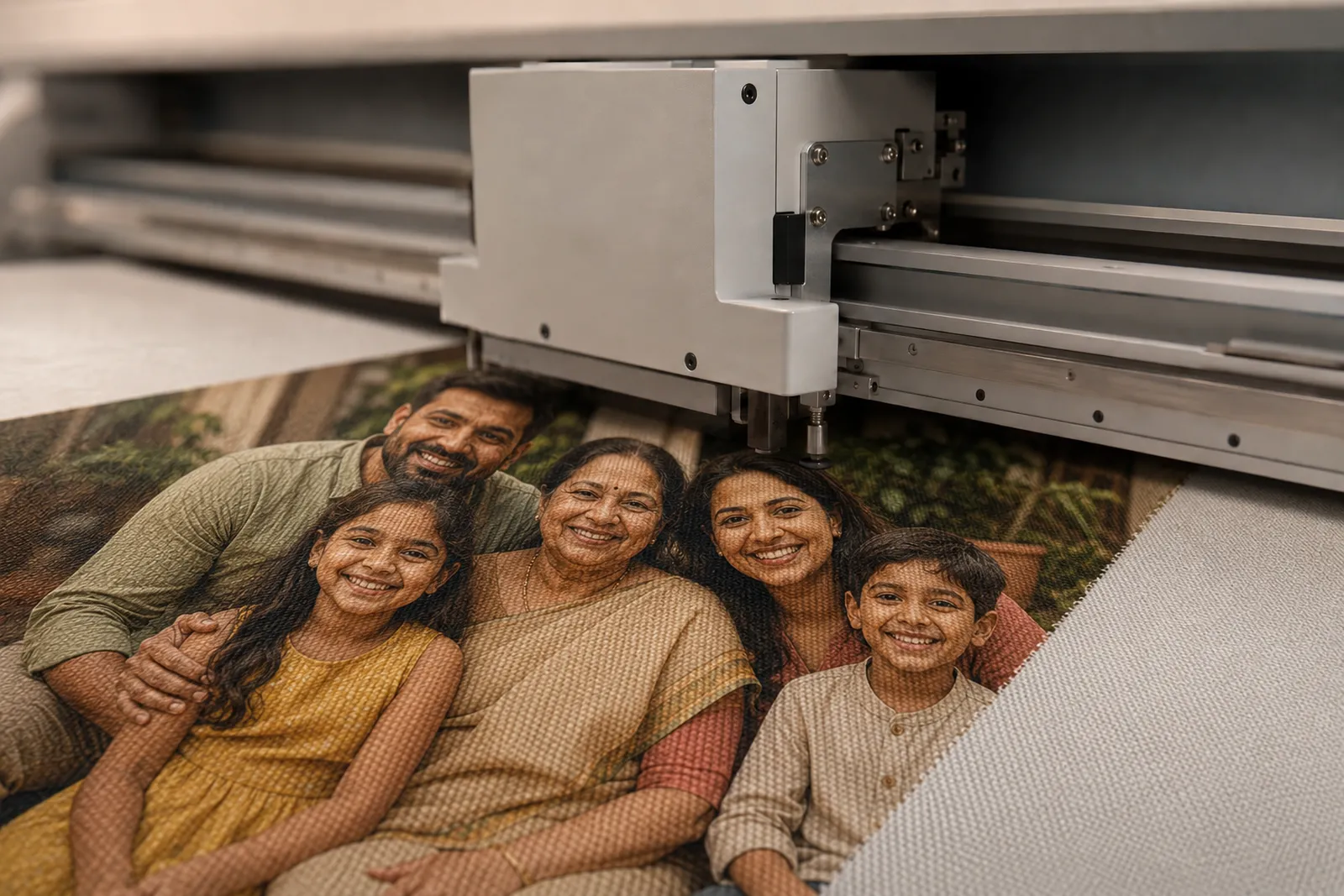
A canvas print is your photo printed on canvas material and stretched over a wooden frame, ready to hang. No glass, no separate frame, no framing shop visit. The photo becomes the object itself: wall art with the texture of woven fabric and the depth of a stretched frame. At picsin.in we make custom canvas prints to order from your photo, in sizes from 8x8 to 54x54 inches, and deliver them anywhere in India.
That is the definition. But two canvas prints can look identical on the day they arrive and look completely different five years later, because almost everything that separates a good canvas print from a cheap one is invisible in a product photo. It sits in the fabric weight, the ink chemistry, the print head that laid the ink down, and the wood behind the canvas. This guide goes through each one, with the actual numbers, so you know exactly what you are paying for, from us or from anyone else.
The four components of every canvas print
Strip away the branding and every canvas print in the world is the same four parts. Quality is decided component by component.
- The canvas fabric: the woven material the photo is printed on. Its weight, fibre and weave decide how ink sits and how long the surface stays taut.
- The ink: dye or pigment. This single choice has the largest effect on how long the print lasts.
- The print engine: the resolution and precision with which ink is placed on the fabric. This decides sharpness, smooth colour gradients and whether faces survive close viewing.
- The stretcher frame and finish: the wooden bars the canvas is pulled over, and the protective coating over the printed surface.
The sections below take these one at a time.
Canvas fabric: why GSM is the number to ask for
Canvas weight is measured in GSM, grams per square metre, the same unit used for paper. It is the fastest single quality signal because it is hard to fake: heavier fabric costs more, holds more ink without bleeding, and resists sagging as seasons change.
We print on 400 GSM cotton canvas. For context, much of the budget canvas sold online is polyester or a poly-cotton blend in the 240 to 280 GSM range. The difference shows in three ways. Cotton fibre is absorbent, so ink bonds into the weave rather than sitting on a coating; polyester is hydrophobic and relies entirely on its surface coating, which gives colours a slightly plastic sheen and can crack at the fold lines where the canvas wraps the frame. Heavier fabric also keeps its tension: a thin canvas stretched over a frame behaves like a drum skin that slowly loosens, and a loose canvas shows a visible ripple in raking evening light. And at the corners, where the fabric is folded and fixed, thin material creases sharply while heavy cotton folds clean.
Ink chemistry: the dye versus pigment decision
Printing inks come in two families, and the difference is physical, not marketing. Dye inks are colourants fully dissolved in liquid, like sugar in tea. They are cheap, bright, and vulnerable: because every colourant molecule is individually exposed, ultraviolet light breaks them down one by one, and moisture can re-dissolve them. Pigment inks instead carry microscopic solid particles of colour, closer to fine sand suspended in water. Each particle is a crystal containing millions of colourant molecules; UV light can only attack its surface, so the colour underneath keeps standing. Pigment particles are also insoluble once dry, which is why they shrug off humidity that would smear a dye print.
This is not our claim alone; it is the consistent finding of independent print-permanence research. Wilhelm Imaging Research, the reference laboratory the photo industry has relied on for decades, rates modern pigment-on-canvas and pigment-on-paper systems at display lives from 60 to well over 200 years depending on ink set and display conditions, while typical dye prints are rated around 25 to 30 years even when kept under glass away from direct light. The printing industry measures the underlying lightfastness on the Blue Wool Scale, an eight-step standard where each step survives roughly two to three times longer than the one below it, and indoor display testing is standardised in ISO 18937-1:2023.
Our canvas prints use fade-resistant pigment inks that hold their colour for over 100 years. The photos people actually put on canvas, weddings, parents, children growing up, are exactly the photos where a seven-year fade quietly destroys the point of the purchase.
Print technology: DPI, PPI and why nozzle count matters
Two numbers get confused constantly, including by sellers. DPI (dots per inch) belongs to the printer: how many individual ink droplets it can place per inch of canvas. PPI (pixels per inch) belongs to your photo file: how much detail the image actually contains at the printed size. A sharp canvas needs both, because a high-resolution printer cannot invent detail that is not in the file, and a high-resolution file is wasted through a coarse printer.
On the printer side, we print at 2400 x 1200 DPI through a 15,360-nozzle precision print head. The nozzle count is worth understanding, because it is the spec that separates photographic printing from banner printing. More nozzles mean smaller droplets placed more densely in a single pass, which is what produces smooth skin tones and clean colour gradients instead of visible banding, the faint horizontal stripes you see across skies and walls on cheaply printed canvas. Large-format machines built for shop signage run far coarser, because a hoarding is viewed from ten metres away. A canvas print is viewed from one metre, and at one metre, banding and grain are exactly what your eye picks up.
On the file side, the working standard for photographic sharpness at arm's length is about 300 pixels per inch. Our photo resolution guide maps this to real file sizes, and the practical answer is friendlier than it sounds: viewing distance does real work for you, so a large wall canvas seen from across a room needs fewer pixels per inch than a small print held in the hand. This is also why we put a person, not just a script, between your upload and the printer: if the file you chose cannot support the size you ordered, we flag it before printing, not after.
The stretcher frame and the coating
The wooden bars behind the canvas are called a stretcher frame, and they matter more in India than almost anywhere else, because wood moves with humidity. We hand stretch every canvas on solid pine wood bars. Pine has a straight grain and a stable relationship with moisture, which is why artist stretcher bars have been pine for generations. The failure mode of cheap alternatives, MDF and softwood offcuts, is warping: the bar bows a few millimetres in its first monsoon, and from then on the canvas face carries a permanent wave that catches light.
Over the printed surface goes the final component: we seal every print with a UV-resistant satin lacquer. The lacquer does three jobs at once. It adds a second layer of UV defence on top of the pigment chemistry, it seals the ink layer against humidity and cooking-adjacent air, and it makes the surface wipeable, so dust comes off with a dry cloth instead of settling into the weave. An unsealed canvas has none of these defences, and unsealed is the default at the cheap end of the market because lacquering is an extra production step.
What longevity means in an Indian home
Most print-longevity numbers you will read online were produced for European and North American living rooms. Indian display conditions are harsher in three specific ways, and they are exactly the conditions the component choices above exist to survive.
Sunlight, first. Indian homes are bright, UV exposure is high for more of the year, and a wall that gets direct afternoon sun will test any print. Pigment particles plus a UV lacquer is the combination built for this; a dye print on the same wall is on a countdown. Humidity, second. A coastal Mumbai or Kochi monsoon pushes indoor humidity past 80 percent for weeks. Dissolved dye colourants and MDF stretcher bars both respond badly to that; insoluble pigment and sealed pine do not. Heat cycling, third. Rooms that swing between 20 and 35 degrees make every material expand and contract daily, which is where taut 400 GSM cotton keeps its tension and thin polyester slowly goes slack. None of this makes a canvas print fragile, the point is the opposite: specified correctly, a canvas print is one of the most durable ways to display a photo in the Indian climate, precisely because nothing in it is glass, gel or loosely bonded dye.
How we make a canvas print, start to finish
The process is identical for an 8 inch desk canvas and a 54 inch feature wall piece.
- You upload the photo from a phone or computer and crop it in the browser, seeing exactly what will print.
- A person reviews it before anything prints: resolution against the ordered size, crop against faces and edges. Problem files get flagged, not printed.
- The photo is printed borderless at 2400 x 1200 DPI on the 400 GSM cotton canvas.
- The canvas is hand stretched over solid pine bars in your chosen depth of 0.5, 1 or 1.5 inch, corners folded clean, then sealed with the UV-resistant satin lacquer.
- The finished piece is inspected again, packed with corner protection, and dispatched in 3 to 5 days with the hanging hook already fitted.
Mounted Canvas and Gallery Wrap, the two styles
Choose Mounted Canvas if you want the full image on the front with a clean white edge. Choose Gallery Wrap Canvas if you want the image to continue around the sides. Mounted suits portraits and any photo with faces near the edge, because nothing wraps away; Gallery Wrap suits landscapes, travel shots and artwork with room around the subject, and reads as gallery art from any angle. Depth is a separate choice: slimmer 0.5 inch profiles sit close to the wall, the 1.5 inch profile gives large statement pieces more presence. For matching sizes to actual walls and sofas, our canvas print size guide covers every size we make, and if you are still weighing canvas against other formats, the canvas vs framed vs acrylic comparison settles it by use case.
File formats: what you can upload, and what actually matters
We accept JPG, PNG, WebP and HEIC files. In practice that covers everything a phone or computer produces today: iPhone photos upload in HEIC without conversion, Android and camera exports arrive as JPG, screenshots and edited graphics as PNG, and images saved from modern apps and sites as WebP.
A more useful truth: for printing, resolution matters far more than format. A 12-megapixel JPG straight off a phone outprints a heavily compressed or repeatedly forwarded file in any format, which is why the single best thing you can do for your canvas is upload the original photo rather than a WhatsApp forward, since messaging apps recompress images hard and strip exactly the detail a large print needs. If your photo exists only as a forward, order a smaller size or a viewing-distance size; the crop preview and the human check will tell you the rest.
A buyer's checklist: how to judge any canvas print
Wherever you buy, these are the questions that separate a print that lasts from one that fades, with the answers you should hear.
- What is the canvas weight and fibre? Look for a stated GSM figure and cotton content. Ours: 400 GSM cotton. No GSM stated usually means light polyester.
- Dye or pigment ink? Only pigment supports a claim measured in decades. Ours: fade-resistant pigment inks, 100+ year colour life.
- What print resolution? A stated DPI signals photographic-grade equipment. Ours: 2400 x 1200 DPI.
- What is the stretcher bar made of? Solid wood, ideally pine. "Wooden frame" with no species named can mean MDF.
- Is the surface sealed? A UV-resistant coating should be named. Unsealed canvas is unprotected canvas.
- Who checks the file? A human preflight check is the difference between a flagged low-resolution file and a soft print at your door.
Any seller doing these things properly will happily answer all six.
What a canvas print costs in India
Our canvas prints start at ₹145 for the smallest size, and you see the exact price of every size, style and depth before you order. Because each canvas is made to order in India, you are not paying for imported stock or shop-floor rent, which is why a made-to-order canvas often costs less than a local framing shop. Delivery reaches every city and pincode in India, free over ₹199, with Cash on Delivery available, and before you pay you can tap 3D View to see your exact canvas at real size on your own wall in AR. Over 10,392 customers have rated us 4.4 out of 5.
If you have the photo, you have everything you need: create your canvas print online, or browse more of our canvas print guides first.
Frequently Asked Questions
What is a canvas print?
How long does a canvas print last?
What makes a canvas print good quality?
What is the difference between DPI and PPI?
What file formats can I upload for a canvas print?
What is the difference between Mounted Canvas and Gallery Wrap?
People Also Ask
What material is a canvas print made of?
Do canvas prints fade in sunlight?
Do canvas prints need a frame or glass?
Is canvas printing good in humid climates?
Related articles
 Christmas
Christmas and New Year Personalised Photo Gift Guide
Skip the generic hampers this Christmas. Personalised photo gifts turn the year's best moments into presents people actually keep.
Read More Birthday
Birthday Gift for Mom: Useful, Personal and Made from Her Own Photos
Mothers take most of the family photos and appear in the fewest. A collage made only of photos of her is a birthday gift she will not have seen coming.
Read More Birthday
Birthday Gifts for Dad: Photo Gifts He Will Actually Hang
When Papa says he needs nothing, he usually means he wants no more clutter. A framed photo of what he is proudest of goes on the wall and stays there.
Read More
Ready To Print Your Own Photos?
Turn your favourite memories into canvas prints, photo frames and photo collages — printed in India and delivered to your door.
Start Creating