
How to Buy Canvas Prints Online in India: A Buyer's Guide
What to check on size, material and finish so the canvas on your wall looks as good as the photo.
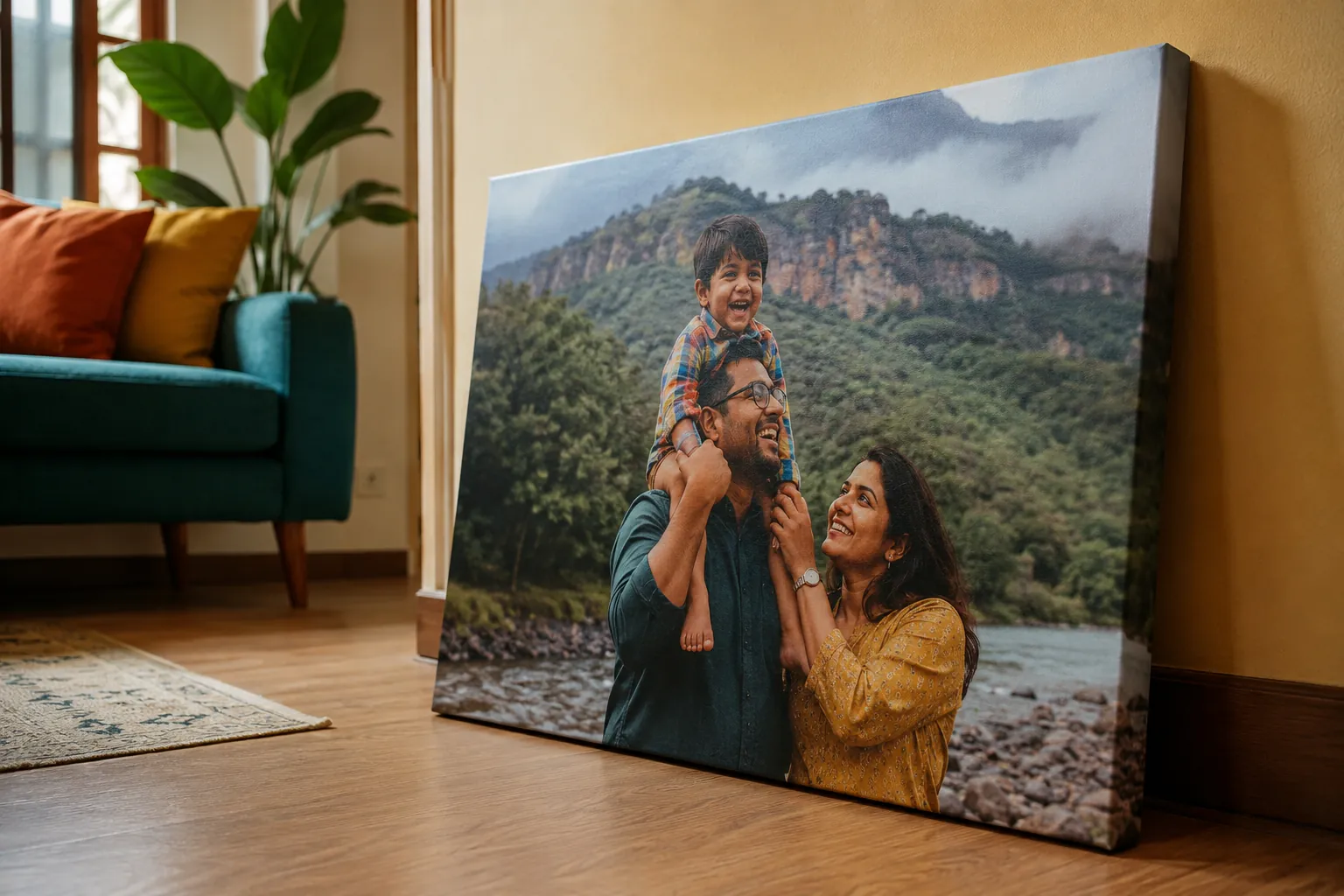
It has never been easier to buy canvas prints online, and that is the problem. Dozens of sites show the same photo on the same wall at wildly different prices, and most tell you almost nothing about what you are actually buying. The canvas that arrives can be a beautiful, lasting piece or a thin, saggy print that fades within a year. The difference is in a few details you have to know to look for. This guide explains what decides canvas quality, then how to order well.
The three things that decide canvas quality
Strip away the marketing and a canvas print is judged on three things. A good seller will state all three; silence on any of them is itself an answer.
1. The canvas material and weight
Canvas is usually cotton, polyester, or a blend. Cotton is the premium choice for photo and fine-art prints: it has a natural woven texture like a painter's canvas and absorbs pigment inks for smooth tonal transitions, which is why museum-grade giclée reproductions use it. Polyester is cheaper and more stable in humidity, so it suits large decorative prints, but cotton is preferred for quality wall art, as canvas-printing guides such as this material guide explain.
Weight matters as much as fibre. Canvas weight is measured in GSM (grams per square metre), and a heavier canvas resists sagging once stretched. Professional canvas prints typically use 340 GSM or more, with 400 to 450 GSM giving durability close to a traditional painting canvas. We print on 400 GSM cotton canvas for exactly this reason.
2. The inks
This is where cheap canvases quietly fail. Pigment inks resist fading far better than dye inks, with a typical lifespan in the range of 75 to 200 years depending on light and conditions, against a few years for poor dye prints. If a listing does not say "pigment", assume the worst. Our canvas uses fade-resistant pigment inks and is finished with a UV-resistant satin lacquer, which is why it is rated to hold colour for over 100 years.
3. How it is stretched
A canvas is only as good as the frame behind it. The print is stretched over wooden stretcher bars, and the quality of that step decides whether it stays flat or ripples over time. Look for even, hand-stretched tension on a solid wooden frame with clean corners. Ours is hand stretched on solid pine wood bars.
Mounted or gallery wrap: choosing the edge
One choice trips people up at checkout, and it is really about what happens at the edges of the canvas. Mounted canvas shows the full image on the front with a clean edge, so details near the sides are safe. Gallery wrap lets the image continue around the sides for a borderless look. If your photo has important content near the edges, choose mounted; if it is a scene with room to spare, gallery wrap looks seamless. Canvas also comes in different depths, and deeper bars read more like gallery art.
Size it for the wall, not the screen
Canvas behaves differently from a framed print on size. Because it has no border, a canvas reads larger than a framed photo of the same dimensions and fills a wall more generously. Still, the most common regret is going too small. The interior-design standard above a sofa is the two-thirds rule: aim for a canvas about two-thirds the width of the furniture, hung with its bottom edge roughly 6 to 8 inches above the sofa back, as set out in this living-room sizing guide. We make canvas from 8x8 to 54x54 inches with custom sizes between, and our canvas print sizes guide walks through which size suits which wall.
Prepare a photo that can take the size
A canvas magnifies whatever you give it, including the flaws. The single best thing you can do is upload the original photo straight from your gallery, not a screenshot or a forwarded copy that has been compressed. Bright, well-exposed photos translate to canvas better than dark ones, and the larger the canvas the more the original resolution matters. iPhone HEIC files print without conversion alongside JPG and PNG. Our resolution guide shows how large you can safely print from a given file, and a person checks every photo before it goes to print.
The buyer's checklist
Before you order anywhere, ask six quick questions:
- What is the canvas made of, and how heavy (GSM) is it?
- Are the inks pigment based, and how long are they rated to resist fading?
- Is it hand stretched on a solid wooden frame?
- Mounted or gallery wrap, and what depth?
- Does a person check the photo before printing?
- Is the full price, including delivery, shown before you pay?
For us the answers are 400 GSM cotton canvas, pigment inks rated over 100 years, hand stretched on solid pine, mounted or gallery wrap in three depths, a human check on every order, and the price shown live as you choose the size. Our canvas prints start at Rs 145, ship free over Rs 199, offer Cash on Delivery, and are dispatched in 3 to 5 business days. If you are still choosing between canvas and a frame, our comparison of canvas, framed and acrylic prints goes deeper, and there is more on the canvas prints blog.
Frequently Asked Questions
What makes a good quality canvas print?
How long do canvas prints last?
What is the difference between mounted canvas and gallery wrap?
Will a phone photo work for a canvas print?
People Also Ask
Is cotton or polyester canvas better for prints?
How big should a canvas print be above a sofa?
Related articles
 Karwa Chauth
Karwa Chauth Photo Gift Ideas for Your Wife
Looking for a Karwa Chauth gift that lasts longer than a bouquet? Personalised photo gifts turn your favourite moments together into something she keeps.
Read More Photo Prints
How to Print Photos Online in India: What to Look For
Printing photos online in India is convenient, but quality varies a lot. Here is how to choose a service, a product and a finish that does your photos justice.
Read More Wedding
Wedding Photo Display Ideas: From Reception to Living Room
What to do with your wedding photos after the album closes: display ideas for the reception, the first home, the bedroom and every anniversary after, matched to the right print format.
Read More
Ready To Print Your Own Photos?
Turn your favourite memories into canvas prints, photo frames and photo collages — printed in India and delivered to your door.
Start Creating